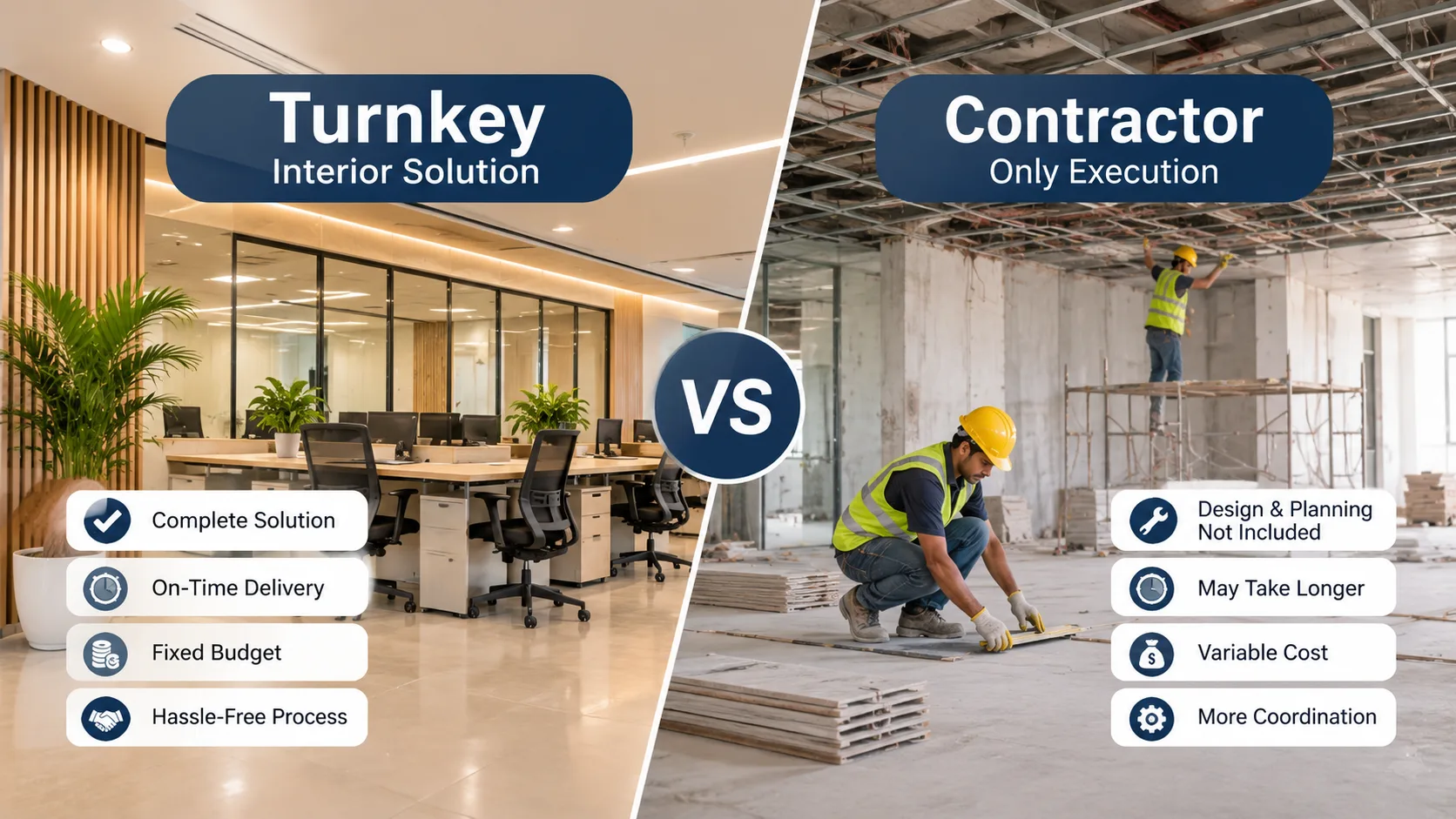
Planning an office interior project involves more than choosing furniture, colours, and layouts. You also need to decide who will manage the design, materials, contractors, installation, and final handover. This decision can affect your total budget, project timeline, and the amount of time you need to spend supervising the work.
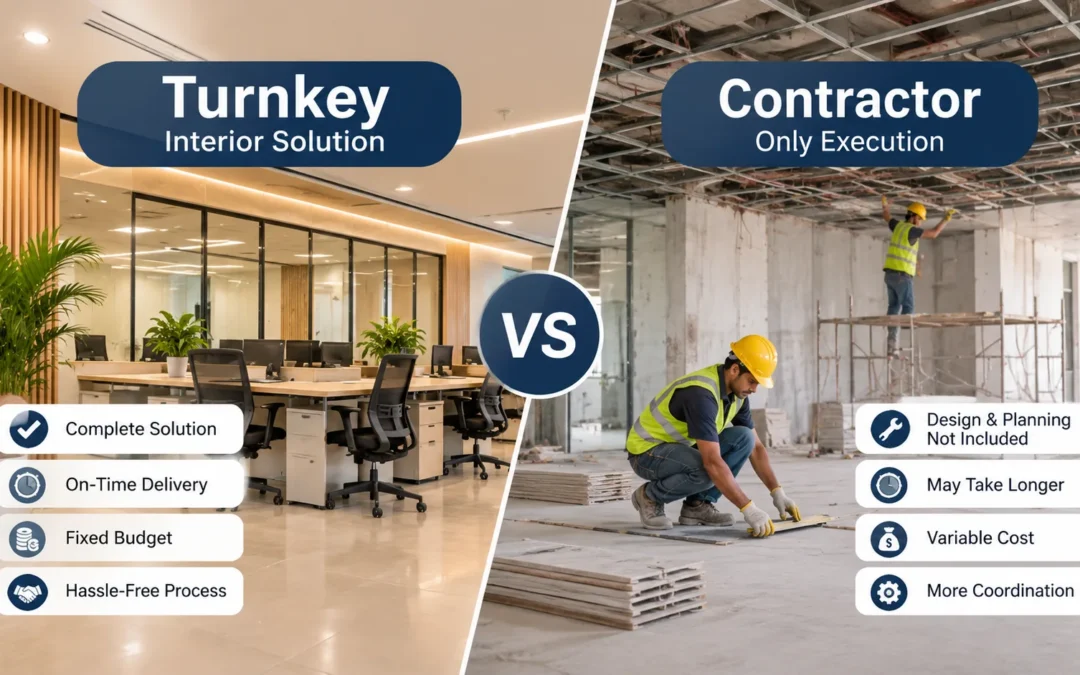
You generally have two options: hire one company to manage the complete office interior project through a turnkey service, or appoint separate contractors for different tasks. Both approaches have advantages, but the right choice depends on your budget, project requirements, and ability to manage the work. Let’s compare them so you can make a practical decision for your office.
What is Turnkey Office Interior Design?
Turnkey office interior design means one company manages the project from initial planning to final handover. Depending on your agreement, the service may include space planning, interior design, 3D visualization, material selection, procurement, construction, furniture installation, and finishing. Your responsibility is mainly to share your requirements, review important decisions, and approve the agreed work.
This approach gives you one main point of contact throughout the project. You do not need to communicate separately with every electrician, carpenter, painter, ceiling installer, or furniture supplier. The company coordinates these activities and works toward delivering a ready-to-use office.
What Does a Turnkey Office Interior Package Include?
The exact package depends on your requirements and the company’s agreement. Before signing, check whether the following services are included in the quotation.
- Space Planning: Organizing workstations, cabins, meeting rooms, reception, and common areas.
- Interior Design: Preparing layouts, design concepts, material selections, and 3D views.
- Material Procurement: Arranging flooring, ceiling, lighting, furniture materials, and finishing products.
- Civil and Interior Work: Managing partitions, flooring, ceilings, painting, and other agreed construction tasks.
- Electrical and Lighting: Coordinating wiring, switches, lighting fixtures, and required electrical points.
- Custom Furniture: Designing and installing workstations, storage units, reception desks, and meeting tables.
- Project Management: Coordinating workers, suppliers, schedules, and site activities.
- Final Handover: Checking completed work and preparing the office for use.
Always confirm the scope in writing because not every turnkey package includes the same services. HVAC, fire safety systems, networking, security, and other specialist installations may be included or treated as separate work.
What is the Traditional Contractor Model?
The traditional contractor model divides your office interior project among different professionals or companies. You may hire an interior designer for planning and drawings, then appoint separate contractors for civil work, electrical installations, furniture, ceilings, and other tasks. Each team handles its own responsibilities, while you or your appointed project manager coordinates the overall process.
This approach gives you more freedom to select suppliers and negotiate individual prices. You can also change a contractor or material supplier if the arrangement does not meet your expectations. However, you need to spend more time checking progress, coordinating schedules, and making sure every team follows the approved design.
How Does the Contractor-Based Approach Work?
Your project usually moves through several separate stages. You first finalize the design and drawings, then collect quotations from different contractors and appoint them for specific work. Each team completes its assigned tasks according to the agreed schedule.
For example, your civil contractor may finish the partitions before the electrical team starts wiring. The ceiling contractor then needs to coordinate with the electrician to complete the lighting installation. If one team delays its work, the next team may also have to wait, which can affect the overall handover date.
Turnkey Office Interior vs Contractor: Key Differences
Both approaches can deliver a functional and attractive office. The main difference is how responsibilities, costs, timelines, and coordination are managed. Review the comparison below before deciding which arrangement suits your business.
| Comparison Factor | Turnkey Office Interior | Separate Contractor Model |
| Project Responsibility | One main company manages the agreed scope | Responsibility is divided among different teams |
| Cost Management | Easier to manage through one detailed project quotation | Requires separate quotations and cost tracking |
| Project Timeline | Centralized scheduling can reduce coordination delays | Depends on coordination between individual contractors |
| Quality Control | One team can maintain consistent project standards | Quality may vary between different teams |
| Vendor Selection | Main company generally manages suppliers | You have direct control over supplier selection |
| Client Involvement | Less daily coordination from your side | More involvement is usually required |
| Design Changes | Changes follow the agreed process with the main company | You can discuss changes directly with individual contractors |
| Accountability | One main point of contact for the agreed work | Issues may involve multiple contractors |
Neither option guarantees a lower cost or faster completion in every situation. Your final result depends on the project scope, contractor experience, material specifications, supervision, and the quality of the agreement.
Which Option Saves More Cost?
The lower initial quotation does not always mean lower overall spending. You need to consider material quality, labour charges, transportation, installation, project supervision, and the cost of delays. Comparing the complete scope will give you a better idea of which option offers value for your money.
Turnkey Office Interior Cost
Turnkey companies usually provide one combined quotation for the agreed design and execution work. This can make budgeting easier because you can review the major project costs before execution begins. Centralized procurement and coordinated scheduling may also help reduce duplicated purchases, unnecessary work, and avoidable delays.
However, the initial turnkey quotation may appear higher than hiring individual contractors. The company may include project management, coordination, procurement, and responsibility for several work packages in its price. Ask for an itemized BOQ so you can understand the actual cost of materials, labour, and services.
Separate Contractor Cost
Hiring separate contractors can help you control individual expenses. You can collect multiple quotations, negotiate rates, and choose materials according to your budget. This approach may save money if you already have trusted suppliers and someone experienced who can manage the project.
However, separate quotations can leave gaps in the overall budget. One contractor may exclude transportation, another may charge separately for installation, and additional work may arise because of coordination problems. Keep a separate cost record for every contractor and include a budget allowance for unexpected requirements.
Which is More Budget-Friendly?
Turnkey can be more cost-effective when your office has several connected work requirements and you do not have an internal team to manage them. Separate contractors may offer better cost control when you have reliable contacts, technical knowledge, and enough time to supervise the work. Compare both options using the same design, specifications, quantities, and project scope before making your decision.
Which Option Saves More Time?
Time matters when you are moving into a new office or renovating an existing workplace. Delayed completion can affect employee productivity, business operations, furniture installation, and your planned moving date. The way you organize different work teams can make a major difference to the schedule.
Turnkey Project Timeline
Turnkey projects generally follow a coordinated schedule managed by one main company. Design, procurement, site preparation, and execution can be planned together, allowing suitable activities to overlap. This can reduce waiting time between work stages when materials and site requirements are properly planned.
You also have fewer separate teams to contact about daily progress. The project manager or assigned representative can provide updates and address coordination issues. However, the timeline still depends on office size, design complexity, material availability, approval speed, and site conditions.
Separate Contractor Timeline
Separate contractors often work in stages, and each team’s progress affects the next activity. Electrical work may depend on partition installation, while ceiling work may depend on electrical and air-conditioning coordination. Delays in one area can therefore affect several other activities.
You may need to contact different contractors, arrange site visits, confirm material delivery, and resolve scheduling conflicts. This takes time, especially if you are also managing your regular business operations. An experienced project manager can reduce these problems, but their involvement should be included in your overall time and cost planning.
Pros and Cons of Turnkey Office Interior
Turnkey services are useful when you want one company to manage most of the work. However, you should understand both the benefits and limitations before choosing this arrangement.
Advantages of Turnkey Services
- One Point of Responsibility
You have one main company to contact about the agreed design and execution work. This makes it easier to discuss progress, report problems, and understand who is responsible for resolving project issues.
- Better Coordination
Designers, procurement teams, and site workers can follow one coordinated plan. This reduces the risk of different teams working with conflicting drawings or making decisions without informing each other.
- Easier Budget Planning
One detailed quotation and BOQ can help you review the project scope and expected costs. You can also discuss material specifications and possible changes before execution begins.
- Less Daily Supervision
Your business team does not need to coordinate every individual contractor. This is particularly helpful if you have limited time or no dedicated facilities manager to supervise the office project.
Disadvantages of Turnkey Services
- Higher Initial Quotation
The combined price may look higher than separate contractor quotations. This can happen because project coordination, procurement, supervision, and other services are included in the package.
- Limited Direct Vendor Control
You may have less freedom to select every individual supplier or worker. Discuss material brands, product specifications, and approval procedures before signing the contract.
- Dependence on One Company
Your project’s progress depends heavily on the selected company’s planning and management. Check its completed projects, team capacity, communication process, and contract terms before making a commitment.
Pros and Cons of Hiring Separate Contractors
Hiring individual contractors gives you more direct control over different parts of the project. This can work well if you have the experience and resources to manage multiple teams.
Advantages of Separate Contractors
- More Vendor Choices
You can compare different suppliers and appoint specialists for specific tasks. This gives you flexibility when selecting materials, furniture makers, electricians, and other service providers.
- Direct Price Negotiation
You can negotiate individual rates and adjust the scope according to your budget. This may help you reduce spending when you understand market prices and know which materials meet your requirements.
- Greater Control Over Materials
You can select products and suppliers directly instead of relying entirely on a main contractor’s procurement arrangements. This is useful if you have specific brand, quality, or design preferences.
Disadvantages of Separate Contractors
- More Coordination Work
You need to make sure every contractor understands the drawings, work sequence, and project requirements. Miscommunication between teams can lead to delays, mistakes, or repeated work.
- Difficulties in Accountability
Problems can occur when one contractor’s work affects another team’s installation. For example, incorrect electrical positioning may require changes to the ceiling work, and both teams may disagree about who should correct it.
- Less Predictable Final Cost
Separate quotations may not cover every requirement from the beginning. Additional labour, material adjustments, transportation, and rework can increase your overall spending.
Which Option Is Better for Your Business?
The right choice depends on how much time, control, and project management support you have. You should also consider the complexity of your office design and the number of different services required. Use your business needs to decide which approach will create fewer problems during execution.
Choose Turnkey Office Interior If:
- You want one company to manage design and execution.
- Your business team has limited time for daily site supervision.
- Your office requires several connected services, such as partitions, ceilings, electrical work, flooring, and custom furniture.
- You want one main point of contact for project coordination.
- You prefer a clearly documented project scope and coordinated handover.
- You need to keep your business operations separate from construction management.
Choose Separate Contractors If:
- You already have trusted and experienced contractors.
- Your company has an in-house project manager or technical team.
- You want to select and negotiate with each supplier directly.
- You have enough time to supervise site activities and monitor progress.
- Your project has a simple scope with fewer coordination requirements.
- You want independent control over design and execution decisions.
How to Choose the Right Office Interior Partner?
Selecting the right company or contractor is just as important as choosing the project delivery model. Do not make your decision based only on attractive 3D designs or the lowest quotation. Review the company’s execution experience, technical capacity, documentation, and communication process before signing an agreement.
1. Review Completed Office Projects
Ask to see completed office projects that are similar in size and requirements to yours. Look beyond photographs and understand how the company handled materials, site challenges, furniture installation, and final delivery. Previous client feedback can also help you evaluate its reliability.
2. Check the BOQ and Quotation
Request a detailed Bill of Quantities that explains the materials, measurements, labour, and individual work costs. Compare quotations using the same specifications so you can identify missing items and differences in quality. Avoid approving a proposal that only provides one total amount without explaining the scope.
3. Understand the Project Management Process
Ask who will supervise the site and how the company will coordinate different work teams. You should know who will provide progress updates, approve material samples, and resolve problems during execution. Clear responsibilities can prevent confusion when several activities happen at the same time.
4. Confirm the Project Timeline
Request a realistic schedule that covers design approval, procurement, site work, installation, and final inspection. Ask how the company plans to handle material delays or unexpected site conditions. A useful schedule should explain the work stages rather than promise an unrealistic completion date.
5. Clarify Material Quality and Specifications
Check the brands, grades, thicknesses, finishes, and other important details before approving the quotation. Review samples for flooring, laminates, boards, lights, glass, and other visible materials where applicable. Written specifications will help you confirm that the installed products match the approved selection.
6. Review the Contract and Payment Terms
Read the agreement carefully before making an advance payment. Confirm the project scope, delivery schedule, payment milestones, warranty terms, exclusions, and process for handling additional work. Keep every approved design change and cost adjustment documented.
How Can You Avoid Extra Costs and Project Delays?
Your choice of turnkey or separate contractors will not automatically prevent budget problems. Good planning, clear documentation, and regular communication are important in both approaches. Follow these practical steps before starting your office interior project.
- Finalize the office layout and major design decisions before execution.
- Prepare a detailed BOQ with clear material specifications and quantities.
- Confirm which services are included and excluded from the quotation.
- Approve material samples before procurement and installation.
- Set realistic project milestones and payment terms.
- Document every design change and additional work request.
- Assign clear responsibility for site supervision and quality checks.
- Inspect completed work before approving the final payment.
Keep some budget flexibility for unexpected site requirements, but do not use it as a substitute for proper planning. Discuss potential risks with your design or execution team before work begins. Clear agreements will help you make decisions without unnecessary pressure during the project.
Frequently Asked Questions
Which Is Cheaper: Turnkey Office Interior or Separate Contractors?
Separate contractors may cost less initially if you can negotiate good rates and manage the work efficiently. Turnkey services may offer better overall value when they reduce coordination problems, repeated work, and delays. Compare the complete project scope and expected management costs before deciding.
Does Turnkey Office Interior Save Time?
Turnkey services can save time because one company coordinates design, procurement, and execution. Different activities can be scheduled together where the work sequence allows it. Actual completion still depends on office size, material availability, design changes, and site conditions.
Can I Choose My Own Materials in a Turnkey Project?
Yes, many turnkey companies allow clients to select materials, colours, finishes, and furniture specifications. The available choices depend on the project agreement and budget. Confirm the approval process before signing so you know which decisions remain under your control.
Can I Hire an Interior Designer and Separate Contractors?
Yes, you can appoint an independent interior designer and hire separate contractors for execution. This gives you more control over vendor selection and design decisions. However, you need a capable project manager or enough time to coordinate the teams and check the completed work.
Who Is Responsible If Something Goes Wrong in a Turnkey Project?
The main company is generally responsible for the work covered by its contract. You should still check the agreement to understand its exact responsibilities, exclusions, and warranty conditions. Written terms make it easier to resolve problems if the delivered work does not match the approved scope.
Is Turnkey Interior Design Suitable for Small Offices?
Turnkey services can suit small offices if you want one team to handle planning and execution. You may find it convenient when your business does not have staff available for daily supervision. Compare the service charge and included work against the cost of hiring individual contractors.
How Do I Compare Two Office Interior Quotations?
Start by comparing the BOQ, material specifications, quantities, labour, installation, and exclusions. Check whether both companies are offering the same scope and quality level. Review their project schedules and contract terms before selecting the proposal.
Make the Right Decision for Your Office Interior Project
Choosing between turnkey office interior services and separate contractors depends on your priorities. Turnkey can make project management easier and reduce your daily involvement, while separate contractors offer more direct control over suppliers, materials, and individual costs. Neither approach is automatically cheaper, so compare the full scope, responsibilities, and expected project costs before making your decision.
If you want support with office interior planning, design, and execution, discuss your requirements with Imagine Interiors. Share your office size, layout, budget, and preferred completion date to help the team understand your project and recommend a suitable approach.