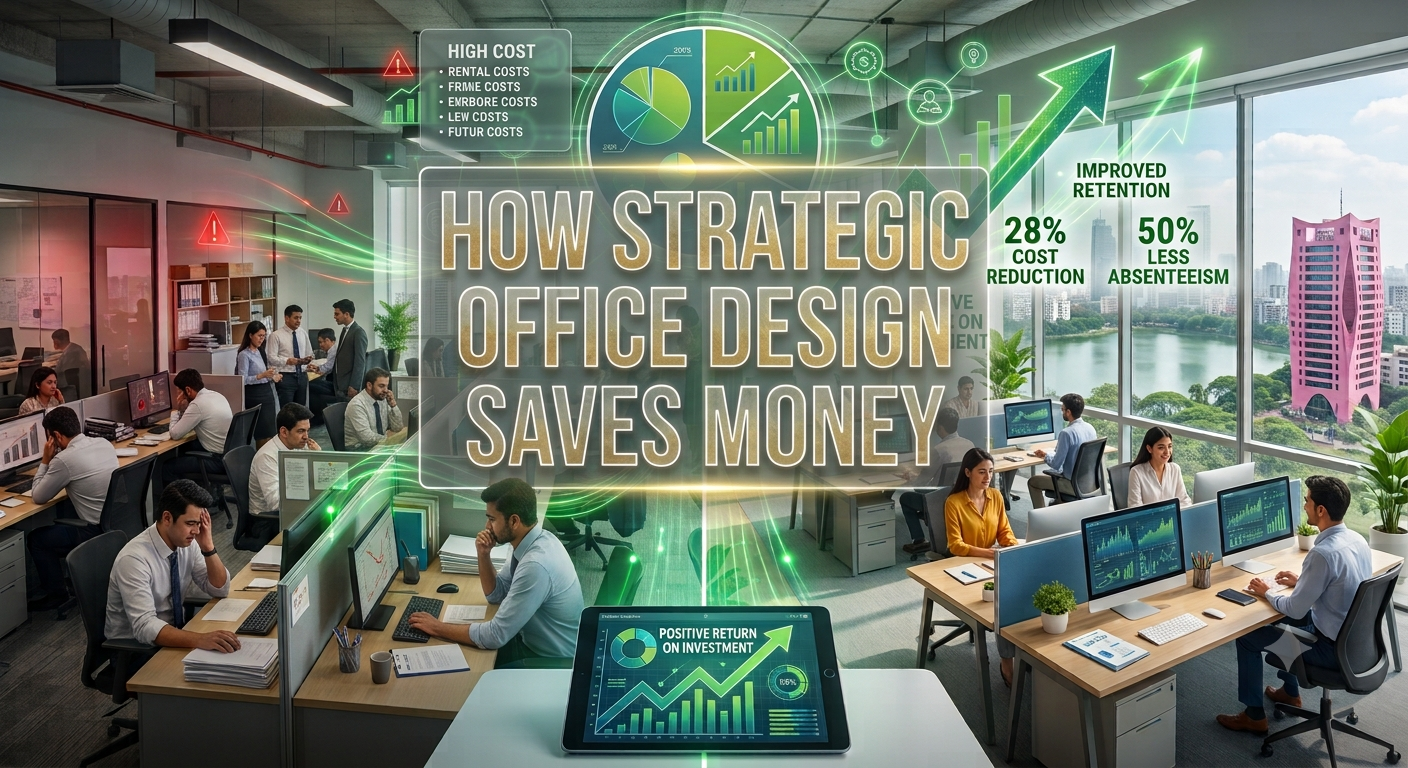
The ROI of office space planning starts with how well your workplace supports people, space, time, and money. It is not only about fitting desks into a floor plan.
I have seen offices with beautiful furniture still feel hard to use. People walk too far for meetings. Quiet work happens beside loud areas. Meeting rooms stay full, while some desks sit empty.
That is not a design issue only, that is a business cost. Good office space planning helps you use your space with more sense. It helps your team work with less friction. And yes, it can protect your budget too.
What Does ROI Mean in Office Space Planning?
ROI means return on investment. In office space planning, it means what your business gets back after improving the workplace. That return may not always show in one clean number. Sometimes it shows in fewer wasted desks.
Sometimes it shows in faster meetings, better focus, lower stress, or less need to move into a bigger office. The main point is simple. Your office should earn its place in your business, not just consume rent every month.
Why Does Poor Office Planning Cost More Than It Looks?
A poorly planned office can look fine at first. Then the small problems start showing up. People cannot find a quiet room. Teams book meeting rooms for simple calls. Desks stay unused. Storage spills into walkways.
The office feels either too crowded or strangely empty. I do not like calling these “small issues.” They steal time every day. And when small issues repeat across a full team, they become real cost.
1. Space Utilization is the First ROI Signal
Space utilization shows how well your office is being used. This is often the first place I look. You may be paying for 100 desks, but only 55 are used on most days. Or you may have a large lounge that nobody uses, while two small meeting rooms are always booked. That tells you something. The office layout does not match the way people work.
What to check –
- Which desks are used most?
- Which desks stay empty?
- Which meeting rooms are always booked?
- Which rooms feel too large or too small?
- Where do people gather naturally?
- Which areas feel wasted?
- Where does traffic feel blocked?
Better space use can delay expansion, reduce waste, and make the same office feel more useful.
2. Better Workflow Saves Time Every Day
Office planning affects how work moves. If your sales team needs to talk with marketing often, they should not feel hidden on opposite sides of the office. If your project team uses a meeting room daily, that room should not be far from their work area.
These details sound simple. But they change the day. When people can move, meet, and access tools easily, work feels smoother. You do not need to force productivity. You just remove the small delays that slow people down.
3. Productivity ROI Comes From Less Friction
Productivity does not only mean doing more work. It often means having fewer things in the way. A noisy desk area can break focus. Poor lighting can make people tired. Bad chair support can make long work harder. A weak meeting setup can waste the first ten minutes of every call.
Good space planning reduces these problems. It gives people the right setting for the task. Focus work needs quiet. Teamwork needs space to talk. Calls need privacy. Meetings need clear screens and sound. That is how layout supports output.
4. Employee Wellbeing Has a Business Return
Employee wellbeing is not a soft extra. It affects how people feel, stay, focus, and show up at work. A workplace with natural light, good seating, quiet rooms, clean movement, and simple break areas feels easier to use. People do not have to fight the space all day. I always notice this in better offices.
People move more naturally. They choose spaces based on the task. They do not look trapped at one desk. That comfort has value. A better office can support better energy, better mood, and better daily work.
5. Collaboration Spaces Can Support Better Decisions
Collaboration needs more than a boardroom. Some conversations need a formal room. Some need a project table. Some need a quick standing spot. Some need a lounge where people can talk without making it feel like a big meeting.
This is where planning matters.If every conversation needs a booked room, work slows down. A good office gives people several ways to meet and share ideas.
Useful collaboration spaces
- Small team rooms for planned work
- Open project tables for quick discussion
- Writable walls for planning
- Lounge corners for informal talks
- Larger rooms for client or board meetings
Better collaboration space helps people solve problems faster.
6. Focus Zones Protect Deep Work
Not all work should happen in open space. Some work needs silence. Some needs privacy. Some needs a room where you can think without hearing three calls around you.
That is why focus zones matter. A focus zone can be a quiet room, a desk area, a booth, or a small library-style corner. It does not need to be fancy.
It just needs to protect attention. When you give people a place for deep work, you reduce distraction. You also show that focus has value in your workplace.
7. Hybrid Work Changes the ROI Calculation
Hybrid work changed office planning. Old offices were often planned around one person and one desk. That does not always make sense now. Some employees come in three days a week. Some come for meetings only. Some need touchdown desks. Some need strong hybrid meeting rooms.
So the question changes. You are not only asking, “How many people do we employ?” You are asking, “How many people use the office, when do they use it, and what do they need when they arrive?” That is a smarter ROI question.
8. Technology Planning Prevents Expensive Fixes Later
Technology should be planned before the furniture arrives. I have seen meeting rooms where the table looked right, but the power access was wrong. Then cables crossed the floor. Screens sat in awkward places. People wasted time fixing calls.
That is not professional, it is avoidable. Plan power, data, screens, cameras, microphones, room booking, and cable paths early.
Technology needs to plan
- Desk power
- Meeting room power
- Video call setup
- Room booking tools
- Screen placement
- Cable management
- Strong Wi-Fi
- Charging points
- Guest network access
Good technology planning saves time and avoids messy fixes later.
9. Furniture Choices Affect Long-Term Value
Furniture affects ROI more than many people think. Cheap chairs can become uncomfortable. Fixed tables can limit future layouts. Weak storage can create clutter. Trendy pieces can look old too fast.
I am not saying every office needs expensive furniture. It does not. But the furniture should match the way people use the space.
Furniture that supports ROI
- Ergonomic chairs for daily work
- Modular desks for changing teams
- Movable tables for flexible rooms
- Durable finishes for high-use areas
- Smart storage for cleaner workspaces
- Soft seating for social or waiting areas
Good furniture should last, move, support people, and fit the work.
10. Brand Experience and Client Trust Also Count
ROI is not only internal. Your office also speaks to clients, partners, visitors, and future employees. People notice if the space feels clear, cared for, and easy to use. They notice the reception area. They notice the meeting room. They notice whether your office matches what your business says about itself.
You do not need logos everywhere. In fact, too much branding can feel forced. Use layout, materials, lighting, furniture, and signs to make the space feel like your company. That quiet brand feeling matters.
How to Measure the ROI of Office Space Planning
You cannot improve what you never measure. Before changing your office, check how it works now. After the change, check again.Keep it simple.
You do not need a complicated system on day one. Start with the most visible signs of waste, comfort, and use.
Metrics to track
- Rent or cost per employee
- Desk usage
- Meeting room usage
- Empty or crowded areas
- Employee satisfaction
- Noise complaints
- Maintenance issues
- Energy use
- Turnover signals
- Time lost finding rooms
- Hybrid attendance patterns
These numbers and signals help you see if the space is helping or hurting the business.
Simple ROI formula
Use this simple formula: ROI = Net Benefit ÷ Project Cost Net benefit means the value you gained after removing the cost of the project.
For example, the benefit may come from using less space, delaying expansion, reducing wasted rooms, improving employee comfort, or lowering daily friction. Do not chase a perfect number. Start with honest measurement.
Questions to Ask Before Redesigning Your Office
Before you invest in office space planning, ask better questions. The right questions can save you from expensive mistakes.
Ask these first
- What work happens most in this office?
- Which spaces are overused?
- Which spaces are underused?
- Where do people lose time?
- Do employees need more quiet or more collaboration?
- How many people use the office on busy days?
- What does hybrid work look like here?
- Are meeting rooms the right size?
- Is the furniture flexible enough?
- Will this layout still work in three years?
These questions keep the design grounded in real use.
Common Mistakes That Lower Office Space ROI
Some office changes cost money but do not create much value. This usually happens when decisions start with looks instead of use. A stylish office can still fail if people cannot focus, meet, move, or use the space well.
Mistakes to avoid
- Planning only by headcount
- Ignoring hybrid work patterns
- Buying fixed furniture for changing teams
- Skipping employee feedback
- Forgetting acoustic planning
- Leaving technology until the end
- Creating too many open areas
- Not measuring desk and room use
- Designing only for visitors
- Forgetting future growth
A good office should look good, yes. But it should work even better.
Final Thoughts
The ROI of office space planning comes from making the workplace easier, smarter, and more useful. You save money when you stop paying for wasted space. You gain value when people can focus, meet, move, and work without daily friction. You protect the future when the office can adjust as the team changes.
So do not treat space planning like decoration. Treat it like a business decision. Because your office is not just where work happens. It is part of how well the work gets done. For budget estimation get consultation with Imagine Interiors